


On May 2, 2026, a group of artists, architects, and kindred spirits gathered at the Zainul Gallery grounds within the beloved Charukola (Faculty of Fine Arts, University of Dhaka) to celebrate the master architect Muzharul Islam, who designed this space more than half a century ago.
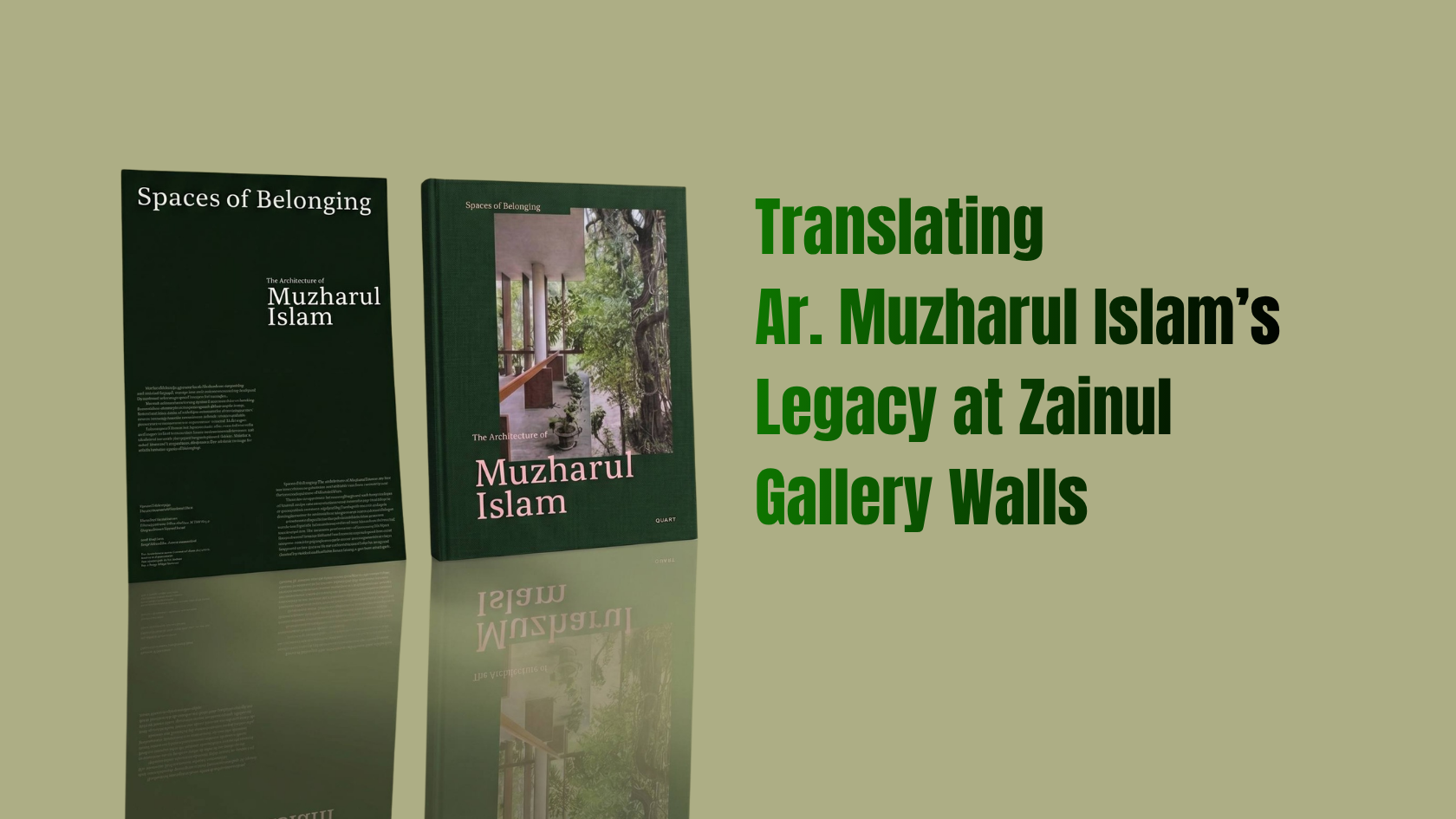
It was not merely an exhibition or a book launch dedicated to his legacy; it felt like a moment of quiet serendipity. It builds on the momentum of the book launch “Spaces of Belonging: The Architecture of Muzharul Islam”, held on 25 April 2026 at the IAB Centre in Dhaka.
This project marks a significant milestone in architectural history as the first internationally published, globally available monograph on the pioneering Bengali architect—bridging Swiss and Bangladeshi architectural discourse while addressing gaps in global representation and celebrating cross-cultural dialogue.
The publication was curated and edited by Niklaus Graber, a prominent Swiss architect, educator, and researcher. A graduate of ETH Zurich and Columbia University in New York, Graber is a co-founder of Graber & Steiger Architects in Lucerne and has long maintained a deep connection with the Bangladeshi architectural scene.
Walking along the curved walls of the Zainul Gallery, the photographs revealed the extraordinary design sensibility embedded in the seemingly ordinary vernacular forms that define Muzharul Islam’s architecture.
The experience compelled me to see my own campus at Jahangirnagar University in a different lense—where even the red bricks feel imbued with character beyond their material presence.
The opening of the exhibition was a quiet, intimate affair, bringing together familiar faces from the creative community, including prominent architects Dr. Abu Sayeed M. Ahmed, Ar. Salauddin Ahmed, and Ar. Saif Ul Haque.
Reflecting on the scope of the publication, Ar Saif Ul Haque, one of the contributors, noted that even at 319 pages, the book still feels too brief to fully encompass Muzharul Islam and the depth of his legacy.
By bringing the monograph’s projects directly into public view, the exhibition becomes an open invitation. According to the editor, it allows even those who may not read the book to engage with its ideas and perhaps feel compelled to explore it further.
The installation of the photographs also carried a quiet poetic intention.
Instead of being rigidly framed, the prints were hung directly by threads. This kept them anchored to the wall, yet left them light enough to catch the wind. As visitors moved through the space and a breeze passed through the open structure, the images gently shifted and swayed.
In Graber’s view, this subtle movement captures the inherent fragility of architecture itself, offering a quiet contrast to more fixed and immovable art forms.
Walking through the Faculty of Fine Arts at the University of Dhaka, it is impossible not to sense the enduring presence of Muzharul Islam. Widely regarded as the architect of Bangladesh’s first true modernist building, Charukola was designed to breathe.
In the sanctuary of the gallery, as rain washed over the red brick surfaces, history, art, and nature converged once again—honouring a master who taught us, in form and space, how to Belong.
The exhibition will remain on view until 6 May 2026 at the Faculty of Fine Arts, University of Dhaka.